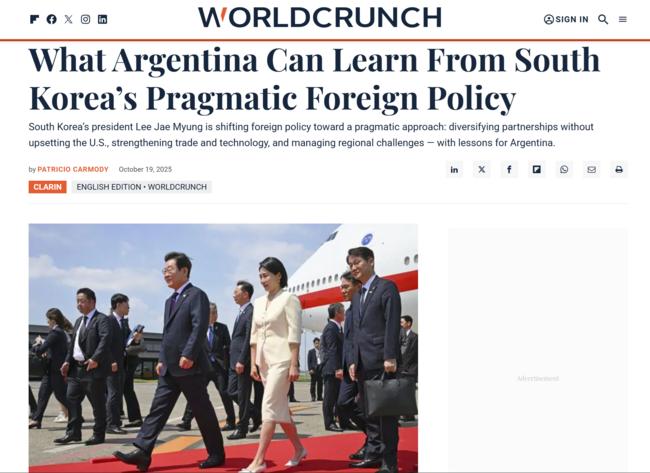
 Worldcrunch 보도자료 (이미지=Worldcrunch 홈페이지)
전 세계의 주요 언론사 기사들을 선별하여 유통하는 글로벌 뉴스 배급사인 월드크런치(Worldcrunch)에서 대한민국 이재명 정부의 실용 외교에 대한 논평과 아르헨티나에 주는 시사점을 보도했다.
저자 패트리시오 카르모디 Patricio Carmody는 아르헨티나에서 활동하며 아르헨티나의 외교 정책을 전문으로 다루는 전문가다.
< 한국의 실용 외교에서 아르헨티나가 배울 점 >
대한민국 이재명 대통령이 대미 관계를 해치지 않으면서 파트너를 다변화하고, 수출 시장을 넓히고 첨단 기술 경쟁력을 높여, 역내 난제들을 관리하는 실용주의 외교로 선회하고 있다. 이는 아르헨티나에게 시사하는 바가 크다.
패트리시오 카르모디, 2025년 10월 19일
동맹 관계가 흔들리고, 지역 긴장이 고조되며, 국제 규범이 약화되는 세상에서 외교란 쉽지 않은 일이다. 한국이 그 대표적인 예다. 한국의 외교 정책은 복잡하기로 정평이 나 있는데, 이재명 대통령이 판을 흔들려는 접근 방식은 아르헨티나에게 몇 가지 교훈을 줄 수 있다.
이재명 대통령은 전임 윤석열 정부의 대립적인 이념/가치 중심 외교에 비판적이며, 말로만 하는 외교가 아니라 실질적인 성과와 국익에 부합하는 접근 방식을 원한다. 그의 최우선 순위는 무엇일까? 지역 평화/안정을 굳건히 하고 경제적 실리를 확보하는 데 있다. 그는 계엄령 선포 논란 등으로 탄핵된 윤석열의 뒤를 이어 지난 6월 취임했다.
탄핵 과정은 한국 사회가 정치적 분열에도 불구하고 민주주의 제도를 얼마나 소중히 여기는지 보여주었다. 윤석열은 민주주의 수호자이자 미국의 충실한 동맹임을 자처했지만, 국내에서는 내란/계엄령 선포로 민주주의 수호 정당성이 크게 훼손됐고, 세계 무대에서는 대한민국 외교의 유연성을 떨어뜨렸다.
이재명 대통령의 주요 목표 중 하나는 미국 의존과 북한 문제 해결이라는 외교의 좁은 틀에서 벗어나는 것이다. 그는 미국과 굳건한 안보 관계를 유지하되, 동남아시아, 일본, EU와의 관계도 심화할 계획이다. 그러면서도 적을 만들 생각이 없음을 분명히 했다. 그는 “중국이나 러시아를 완전히 배제하거나 공격적으로 대할 필요는 없다”고 말했다.
미·중 경쟁의 덫에 빠지지 않기
이재명 대통령의 기조는 '주요 국가들 특히 미국과의 관계를 훼손하거나 적대적으로 만들지 않으면서, 다른 나라들과의 관계를 넓혀나간다'로 요약할 수 있다. 사실 이런 구상은 완전히 새로운 것은 아니다. 대한민국은 이미 2010년부터 주변 4강인 미국, 중국, 일본, 러시아를 넘어 관계를 넓히려는 시도를 해왔다.
대한민국은 희토류 접근, 기술 파트너십, 산업 표준에 대한 영향력이 필요
이제 그 전략은 글로벌 차원이다. 미국의 군사 지원을 유지한 채 영향력을 확대하고, 미-중 경쟁의 덫에 빠지는 것을 피하며, 특정 강대국에 대한 경제적 의존도를 줄이는 것이다. 지난 8월 워싱턴에서 열린 트럼프 대통령과의 만남은 이러한 균형 잡기의 분명한 사례였다.
이재명 대통령은 이러한 다변화를 한국의 실질적인 강점과 긴밀하게 연결하길 원한다. 이는 원활한 글로벌 공급망을 갖추고, 에너지 자립도를 높이며, 첨단 기술 자립과 상호 긴밀하게 얽혀있는 상호 의존 관계를 전략적으로 활용하는 것을 의미한다. 한국은 이미 조선, 전기차, 군용기부터 반도체, 배터리, 통신 기술까지 산업과 혁신 분야에서 뛰어난 역량을 갖추고 있다.
앞으로 나아가기 위해 대한민국은 희토류 접근성, 기술 파트너십, 그리고 산업 표준에 대한 영향력을 확보해야 한다. 글로벌 사우스(Global South) 지역의 디지털 인프라 확장과 신재생 에너지 및 산업 자동화에 대한 투입도 핵심 우선순위다. 도전 과제는 실용적인 다변화와 영리한 산업 정책을 결합하는 것이다.
강대국 관리하기
‘주요 국가들과의 관계를 훼손하거나 적대적으로 만들지 않으면서, 다른 나라들과의 관계를 넓혀나간다’는 것은 미국과의 관계를 신중하게 다루어야 한다는 의미이기도 하며, 북한 문제가 사라지는 것도 아니다. 미국과 관련해서 이 대통령은 무역과 안보를 까다롭게 엮는 트럼프 대통령을 상대해야 한다. 트럼프 대통령은 한국 수출품에 대한 관세, 주한미군 주둔 비용 증액 요구, 그리고 추가적인 군사적 책임 요구 등을 내세우고 있다.
북한 문제에 대해서는 윤석열 정부의 강경 노선 이후 대화 채널을 열려는 입장이다. 그는 강력한 군사적 억제력은 유지하면서도 평양과의 대화를 재개하기를 희망한다. 또한 관여가 핵심이라고 보기에 미래의 트럼프-김정은 회담에도 찬성하는 입장이다.
외교 정책은 이념에 치우치기보다 실용적으로 유지되어야
이재명 대통령의 접근 방식 중 몇 가지 측면은 아르헨티나와 관련이 깊다. ‘주요 국가들과의 관계를 훼손하거나 적대적으로 만들지 않으면서, 다른 나라들과의 관계를 넓혀나간다’는 아르헨티나가 미국과의 관계를 관리하는 동시에 미국과 중국에 대한 의존도를 줄이는 데 도움이 될 수 있다.
아르헨티나의 경우, 다변화는 농축산업, 에너지, 광업, 정보 산업, 그리고 역내 및 세계적으로 경쟁할 수 있는 산업 부문 등 자국의 실질적인 전략적 강점 분야에 초점을 맞춰야 한다.
동시에 외교 정책은 이념에 치우치지 않고 실용적으로 유지되어야 한다. 미국에 안보를 의지하는 한국에게도 일방적인 대미 의존이 부담이라면, 안보 의존도가 상대적으로 낮은 아르헨티나에게는 더욱더 도움이 될 리 없다.
여러 나라와 관계를 맺는 전략적 다변화는 미국을 배신하는 것이 아니다. 그것은 복잡하게 얽힌 국제 정세 속에서 국가 주권을 실현하는 현명한 방식일 뿐이다.
< What Argentina Can Learn From South Korea’s Pragmatic Foreign Policy >
South Korea’s president Lee Jae Myung is shifting foreign policy toward a pragmatic approach: diversifying partnerships without upsetting the U.S., strengthening trade and technology, and managing regional challenges — with lessons for Argentina.
by Patricio Carmody
October 19, 2025
BUENOS AIRES — Foreign policy isn’t easy, especially in a world of shifting alliances, rising regional tensions, and weakening international norms. South Korea is a clear example. Its foreign policy is notoriously complex, and the country’s new president, Lee Jae Myung, is looking to shake things up — an approach that could offer some lessons for Argentina.
Lee is critical of his predecessor’s “values-driven” diplomacy, and wants a more practical, interest-focused approach. His priorities? Regional stability and securing trade. He took office in June, after the impeachment of Yoon Suk Yeol — partly over his declaration of martial law.
The impeachment showed how much South Korean society values its democratic institutions, even though the political culture remains fragmented. Yoon had presented himself as a staunch defender of liberal norms and a loyal ally to the U.S., but that stance limited his legitimacy at home and reduced Seoul’s flexibility on the global stage.
One of Lee’s main goals is to move beyond South Korea’s traditional dependence on the U.S. and the usual North Korea-focused diplomacy. He still wants strong security ties with Washington, but also plans to deepen relations with Southeast Asia, Japan, and the EU. At the same time, he has made it clear that he is not interested in having enemies. “We do not need to totally exclude or be aggressive toward China and Russia,” he said.
Sino-American rivalry trap
Lee’s motto could be summed up as “diversify without alienating,” especially the U.S.. The idea isn’t entirely new — Seoul began exploring broader ties in 2010, trying to look beyond the main regional powers: the U.S., China, Japan, and Russia.
Seoul needs access to essential minerals, tech partnerships, and influence over industrial standards.
Now, the strategy is global: expand influence, avoid getting trapped in U.S.-China rivalry, and reduce economic dependence on any single power — all while keeping American military support intact. Lee’s meeting with President Donald Trump in Washington last August was a clear example of this balancing act.
Lee wants this diversification to be closely tied to South Korea’s real strengths. That means securing supply chains, boosting energy resilience, and managing technological interdependence. South Korea already excels in industry and innovation — from shipbuilding, electric vehicles, and military aircraft to semiconductors, batteries, and communication technologies.
To keep moving forward, Seoul needs access to essential minerals, tech partnerships, and influence over industrial standards. Expanding digital infrastructure in the Global South and investing in renewable energy and industrial automation are also key priorities. The challenge is combining practical international diversification with smart industrial policy.
Managing big powers
“Diversify without alienating” also means carefully handling the U.S. relationship — and it doesn’t make North Korea disappear. With Washington, Lee has to deal with Trump, who blends trade and security in tricky ways: tariffs on South Korean exports, demands for higher contributions to US troops, and calls for extra military responsibilities.
With North Korea, Lee wants to open channels after Yoon’s aggressive approach. He hopes to restart dialogue with Pyongyang while keeping military deterrence strong. He’s also in favor of future Trump-Kim meetings, seeing engagement as key.
Foreign policy should remain pragmatic, not driven by ideology.
Several aspects of Lee’s approach are relevant for Argentina. “Diversify without alienating” can help Buenos Aires manage its relationship with Washington while also reducing dependence on both the U.S. and China.
For Argentina, diversification should focus on areas of real strategic strength: agriculture and livestock, energy, mining, information industries, and industrial sectors that can compete regionally and globally.
At the same time, foreign policy should remain pragmatic, not driven by ideology. If blind loyalty to Washington is a problem for South Korea — a country whose security relies on the US — it is even less helpful for Argentina.
Strategic diversification isn’t disloyalty. It’s simply another way of exercising sovereignty in a complicated world.




 한국 주식을 언제든/어디서든/믿고/편리하게 살 수 있게 시간/공간/불신/불편 장벽 해소
 현대자동차그룹 '2026 CES 선언'의 의미
 21세기 천상열차분야지도, 스피어엑스 우주 지도
 한일 정상회담 및 주요 성과 관련 대국민보고
 혐오하지 않을 용기
 목록
목록