미국의 대표적인 외교 전문지인 포린 폴리시(Foreign Policy)는 25.9.11일(금), '한국 국민 316명이 겪은 미국 조지아 체포/구금 8일 간의 악몽'에 관한 기사를 보도했다.
포린 폴리시(Foreign Policy)는 1970년에 창간되었으며, 주로 외교 정책, 국제 관계, 정치 경제 등 글로벌 이슈에 대한 심층 분석과 논평을 제공한다. 미국의 외교 정책과 미국 정부의 정책 결정 과정에 영향을 미치는 여론을 형성하는 데 중요한 역할을 하고 있다. 뉴욕타임스나 워싱턴포스트가 일반 독자를 대상으로 국제 뉴스를 보도한다면, 포린 폴리시는 국제 정치와 외교 정책에 관심이 많은 전문가 및 정책 입안자를 주요 독자로 삼는다.
아래는 기사 전문이다.
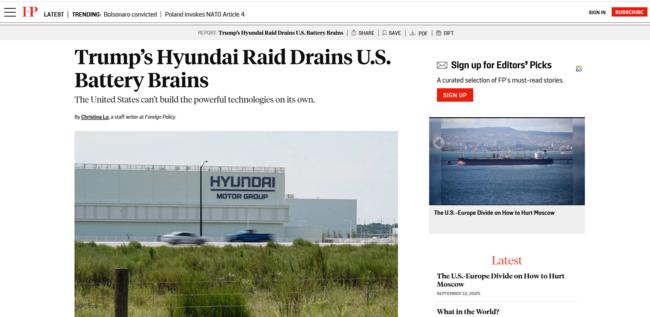 포린 폴리시(Foreign Policy) 보도 (이미지=포린 폴리시)
「트럼프의 현대차 단속, 미국 배터리 산업의 '두뇌'를 고갈시키다」
미국은 첨단 기술을 구축할 수 없다.
크리스티나 루(Christina Lu), 포린 폴리시 기자
미국은 핵심 산업에서 국내 제조업 붐을 일으키기 위해 온갖 노력을 기울이고 있지만, 드론, 전기차 등을 뒷받침하는 강력한 기술인 배터리를 만드는 데 있어 여전히 아시아의 전문 지식에 크게 의존하고 있습니다.
이러한 현실은 지난주 미국 이민 당국이 조지아주의 전기차 배터리 공장 건설 현장을 급습하여 약 475명의 노동자를 구금하면서 여실히 드러났습니다. 구금된 노동자의 대부분은 한국 국적자들이었습니다. 해당 공장은 한국 자동차 제조업체 현대와 공동 소유입니다. 미국 당국은 이번 단속이 미국 국토안보부 역사상 단일 현장에서 이루어진 가장 큰 규모의 법 집행 작전이었다고 밝혔습니다.
이번 단속은 오랜 동맹국인 한국과의 외교적 분쟁을 촉발시켰고, 미국 배터리 산업의 현주소에 대한 주목을 끌었습니다. 배터리는 군용 드론과 잠수함을 포함한 전 세계 최첨단 국방 및 에너지 기술에 필수적입니다. 그러나 미국 산업은 자국 분야를 성장시키기 위해 여전히 외국의 노하우에 깊이 의존하고 있으며, 전문가들은 트럼프 행정부의 현대차 단속이 추가적인 투자를 더욱 위축시킬 위험이 있다고 경고합니다.
독립적인 금속 분석 컨설팅업체 하우스 마운틴 파트너스(House Mountain Partners)의 대표 크리스 베리는 "우리는 이 기술을 구축하고 확장하기 위해 외국의 도움이 필요합니다"라고 말했습니다. 그는 "미국 인력으로는 이렇게 최첨단 기술을 다루는 공장을 건설할 수 없을 것"이라고 덧붙였습니다.
전문가들은 외국 기업들이 해외 사업을 처음 확장할 때 자국 인력에 의존한 후 현지 인력을 훈련시키는 것은 이례적인 일이 아니라고 말합니다.
이전에 미국상공회의소 산하 한미 비즈니스 협의회 회장을 역임한 국제 비즈니스 컨설턴트 태미 오버비는 "초기에는 경영 기술을 이전하는 동안 한국인 직원 수가 많지만, 그들은 가능한 한 빨리 지식을 이전하고 본국으로 돌아가기 때문에 회사 입장에서는 비용이 덜 든다"고 말했습니다.
이재명 대통령도 목요일 비슷한 점을 강조했습니다. "이것은 장기적인 영구 고용이 아니라 공장을 위한 시설과 장비를 설립하기 위한 것입니다. 우리는 기계와 장비를 설치할 기술자들이 필요합니다. 미국에는 그러한 인력이 없고, (우리 노동자들이) 머물며 일할 수 있는 비자도 주지 않습니다." 그는 미국이 비자 문제를 신속히 해결하지 못하면 한국 기업들이 미국에 "직접 투자를 하는 것을 주저할 것"이라고 워싱턴에 경고했습니다.
미국 배터리 산업의 전문성 부족을 드러낸 현대차 사건
현대차 사건은 미국 배터리 제조 전문성의 현주소를 보여주었습니다. 국제에너지기구(IEA)에 따르면, 오늘날 세계 최대의 배터리 강국은 중국으로, 전 세계에서 판매되는 모든 배터리의 4분의 3 이상을 생산하며, 다른 경쟁국들보다 훨씬 저렴하고 효율적으로 생산합니다. 중국은 지금까지 생산된 모든 전기차 배터리의 70% 이상을 공급하여, 풍부한 제조 및 생산 전문성을 축적했습니다.
중국에 이어 한국과 일본은 해외 투자를 활발히 하는 세계적인 배터리 강국입니다. 특히 한국 기업들은 해외 제조 능력에서 선두를 달리고 있으며, 지난해 전 세계 전기차 배터리 수요의 20% 이상을 충족했습니다.
베리는 "특히 한국, 일본, 중국은 이 배터리 기술과 화학, 그리고 장단점을 모두 이해하고 있을 뿐만 아니라, 빠른 속도로 규모를 확장하는 방법도 알고 있습니다"라고 말했습니다.
미국 배터리 붐을 일으키기 위해 바이든 행정부는 인플레이션 감축법(IRA)이라는 획기적인 기후 법안을 활용했습니다. 이 법안은 막대한 세제 혜택을 통해 국내 제조업을 장려하고 해당 부문에 대한 새로운 투자와 관심을 유도했습니다. 2023년 벤치마크 미네랄 인텔리전스(Benchmark Mineral Intelligence)의 분석가 마니시 두아(Manish Dua)는 IRA를 "판도를 바꾸는 법안"이라고 평가하며, "막대한 보조금과 세액 공제는 청정 기술 분야 전체에 걸쳐 민간 부문의 참여를 촉진했다"고 말했습니다.
도널드 트럼프 대통령은 이와는 정반대 방향으로 가고 있습니다. 미국의 청정 에너지 부문을 약화시키고, 바이든의 여러 세제 혜택을 무효화하며 더 많은 화석 연료 생산을 촉진하려는 일련의 조치를 취하고 있습니다. 배터리의 핵심 시장인 전기차를 겨냥한 트럼프 행정부의 정책은 배터리 공급망을 장악하고 있는 중국과의 무역 전쟁과 함께 미국 배터리 부문에 새로운 불확실성을 주입했습니다.
동시에, 미국 에너지부는 배터리 제조 및 재활용을 촉진하기 위해 최대 5억 달러의 자금 지원 기회를 발표했으며, 미국 자동차 제조업체들은 미국을 배터리 경쟁의 선두로 이끌고자 열망하고 있습니다.
올해 초, 제너럴 모터스(GM)의 배터리 책임자 커트 켈티는 북미가 "중국으로부터 전기차 배터리 리더십을 확보해야 한다"고 촉구했습니다.
켈티는 "배터리 기술을 발전시키고 혁신을 주도하며, 국내 생산을 강화하고, 우리 공급망을 세계에서 가장 경쟁력 있게 만듦으로써, 우리는 더 나은 배터리뿐만 아니라 미래를 위한 더 강력하고 탄력적인 미국 산업을 구축하고 있다"고 말했습니다.
'전략적 자책골'
전문가들은 미국 기업들이 실제로 배터리 연구 및 혁신, 특히 새로운 배터리 화학 물질 개발에서 큰 진전을 이루었지만, 이는 배터리 방정식의 한 부분일 뿐이라고 말했습니다.
벤치마크의 정책 전문가 브라이언 빌은 "연구 및 개발과 이를 산업적, 상업적 수준으로 실제로 확장하는 것 사이에는 때때로 격차가 있다"고 말했습니다. "그것이 바로 중국이 정말 잘하는 분야입니다."
현대차 단속 며칠 후, 트럼프 대통령 자신도 외국인들이 미국 배터리 제조의 격차를 메우는 데 도움을 주었다는 것을 인정했습니다. 트럼프는 일요일에 "이 나라에는 배터리에 대해 아는 사람이 없습니다"라고 말했습니다. "어쩌면 우리는 그들을 좀 돕고 몇몇 사람들을 들어오게 해서 우리 사람들을 훈련시켜야 할 수도 있습니다."
트럼프는 또한 "우리는 전문가들을 데려와서 우리 국민들이 스스로 할 수 있도록 훈련시킬 수 있는 방법을 찾아야 한다"고 덧붙였습니다.
하지만 미국의 이민 규정과 이번 현대차 단속은 다른 한국 및 국제 기업들에게도 충격을 주었으며, 트럼프가 미국 제조업 역량을 강화하고 기업들이 미국으로 생산을 이전하도록 유도하는 큰 계획의 일환으로 유치하려 했던 바로 그 투자를 위축시킬 위험이 있습니다. 워싱턴포스트의 보도에 따르면, 미국에는 외국 기업이 건설 목적을 위해 숙련된 노동자들을 단기간 데려올 수 있는 비자 프로그램이 없습니다.
이번 단속의 여파는 이미 나타나고 있을 수 있습니다. 한국 정부 관계자들은 목요일, 트럼프가 체포된 수백 명의 노동자들에게 미국에 남아 미국인 노동자들을 훈련시킬 수 있도록 허용할 것을 제안했다고 밝혔습니다. 하지만 관계자들은 한국인 노동자 중 단 한 명만이 남기로 결정했다고 말했습니다.
오버비는 미국에 투자하는 많은 대형 외국 기업들이 "상당히 충격을 받았을 것"이라고 말했습니다. "이는 모든 사람에게 잠시 멈춰 서서 자신의 직원뿐만 아니라 계약업체, 하청업체, 공급망의 모든 사람들을 위한 이민 규정 준수 여부를 검토하게 하는 계기가 될 것입니다."
단속 이후, 한국 기업들은 미국 내 최소 22개 프로젝트의 작업을 중단했으며, 현대차 사장은 블룸버그 통신에 이번 사건으로 배터리 공장 건설이 "최소 2~3개월 지연"되었다고 말했습니다.
베리는 이번 사태를 "일종의 자책골(own-goal)"로 보고 있습니다. "미국은 지금 제 얼굴에 침 뱉기를 하고 있습니다."
「Trump’s Hyundai Raid Drains U.S. Battery Brains」
The United States can’t build the powerful technologies on its own.
By Christina Lu, a staff writer at Foreign Policy.
For all of its efforts to drive a domestic manufacturing boom in key industries, the United States remains heavily reliant on Asian expertise to build batteries, the powerful technologies that underpin drones, electric vehicles, and much more.
It’s a reality that was laid bare last week when U.S. immigration officials raided an EV battery plant construction site in Georgia and detained around 475 workers, most of whom were South Korean nationals. The plant is co-owned by Hyundai, a South Korean carmaker. U.S. authorities said the raid was the biggest single-site enforcement operation in the Department of Homeland Security’s history.
The raid ignited a diplomatic firestorm with longtime U.S. ally South Korea and has cast a spotlight on the state of the U.S. battery sector. Batteries are essential to powering many of the world’s most cutting-edge defense and energy technologies, including military drones and submarines. Yet the U.S. industry remains deeply dependent on foreign know-how to grow its own sector, and experts warn that the Trump administration’s Hyundai crackdown risks further spooking investment.
“We are reliant on foreign help to build and scale this technology,” said Chris Berry, the president of House Mountain Partners, an independent metals analysis consultancy. “The United States labor force is not going to be able to build these types of extremely technically detailed plants without foreign help.”
It’s not unusual for foreign companies to first rely on their own talent when initially scaling up operations overseas and then train a local workforce, experts said.
“The number of Korean employees at the beginning, while they’re transferring the management technology, [is] higher—and then as quickly as they can, they transfer that knowledge, and then they go home, and it’s less expensive for the company,” said Tami Overby, an international business consultant who previously headed the U.S.-Korea Business Council at the U.S. Chamber of Commerce.
South Korean President Lee Jae-myung made a similar point on Thursday: “This isn’t long-term permanent employment but to establish facilities and equipment for factories; we need technicians to install machinery and equipment. The U.S. doesn’t have such personnel, and they won’t give visas for [our workers] to stay and work.”He warned Washington that South Korean businesses would “hesitate to make direct investments” in the United States if it failed to resolve visa issues quickly.
The Hyundai case has exposed the state of U.S. battery manufacturing expertise. Today, the world’s biggest battery powerhouse is China, which produces more than three-quarters of all batteries sold globally—and does so significantly more cheaply and efficiently than its global competitors—according to the International Energy Agency (IEA). China is the source of more than 70 percent of all EV batteries ever produced, driving ample manufacturing and production expertise.
After China, South Korea and Japan are global battery giants that have made hefty overseas investments. Korean firms in particular top the charts in overseas manufacturing capacity, and last year Korean producers filled more than 20 percent of global electric car battery demand.
“The Koreans, the Japanese, and the Chinese in particular all really understand the technology behind these batteries and the chemistries and the pros and the cons—but they also understand how to scale at speed,” Berry said.
To fuel a U.S. battery boom, the Biden administration harnessed its landmark climate bill, the Inflation Reduction Act (IRA), which used hefty tax incentives to encourage domestic manufacturing and drive new investment and interest in the sector. The IRA was “game changing legislation,” Manish Dua, an analyst with Benchmark Mineral Intelligence,said in 2023. “Massive outlay of subsidies and tax credits has boosted private sector participation across the whole cleantech space.”
U.S. President Donald Trump has gone in another direction entirely, with an onslaught of moves meant to gut the U.S. clean energy sector,unwind many of the Biden tax credits, and unleash more fossil fuel production. The Trump administration’s targeting of EVs—a key market for batteries—has injected fresh uncertainty into the U.S. battery sector, as has its trade war with China, which dominates battery supply chains.
At the same time, the U.S. Energy Department has announced up to $500 millionin funding opportunities to boost battery manufacturing and recycling, and U.S. automakers are eager to propel the United States to the forefront of the battery race.
Early this year, General Motors battery chief Kurt Kelty urged North America to “seize EV battery leadership from China.”
“By advancing battery technologies and driving innovation, strengthening our onshoring, and making our supply chain the most competitive in the world, we’re building not just better batteries but a stronger and more resilient U.S. industry for the future,” Keltysaid.
U.S. firms have indeed made big strides in research and innovation for batteries, particularly with developing new battery chemistries. But that’s just one part of the battery equation, experts said.
“There is sometimes a gap between research and development and really scaling it up at an industrial and a commercial level,” said Bryan Bille, a policy expert at Benchmark. “That’s basically what China is really good at.”
Days after the Hyundai raid, Trump himself acknowledged that there was a gap in U.S. battery manufacturing that foreigners have helped plug. “You don’t have people in this country who know about batteries,” Trump said onSunday. “Maybe we should help them along and let some people come in and train our people.”
“We do have to work something out where we bring in experts so our people can be trained so they can do it themselves,” Trump added.
Yet U.S. immigration rules and the Hyundai raid—which has sent shockwaves through other Korean and international firms—also risk deterring the very investment that Trump has been courting as part of his big plan to build up U.S.manufacturing might and push companies to bring production to the United States. The United States lacks a visa program for foreign companies that wish to bring in skilled workers for a short-term period for construction purposes, theWashington Post reported.
The fallout from the raid may already be biting. South Korean officials said on Thursday that Trump offered to allow hundreds of those arrested workers to stay in the United States to train an American workforce. But only one Korean worker decided to stay, the officials said.
Many of the large foreign investors in the United States are likely “quite shocked,” Overby said. “It gives everyone a moment to take a breath and review their immigration compliance rules and regulations, not just for their employees but for contractors, subcontractors, everyone up and down the supply chain.”
After the raid, South Korean firms have halted work on at least 22 projects in the United States, and Hyundai’s chief told Bloomberg that the incident had resulted in a “minimum two to three months delay” on the battery plant.
“I look at it as a little bit of an own-goal,” Berry said. “We’re cutting off our nose to spite our face here in the United States.”




 한국 주식을 언제든/어디서든/믿고/편리하게 살 수 있게 시간/공간/불신/불편 장벽 해소
 현대자동차그룹 '2026 CES 선언'의 의미
 21세기 천상열차분야지도, 스피어엑스 우주 지도
 한일 정상회담 및 주요 성과 관련 대국민보고
 혐오하지 않을 용기
 목록
목록