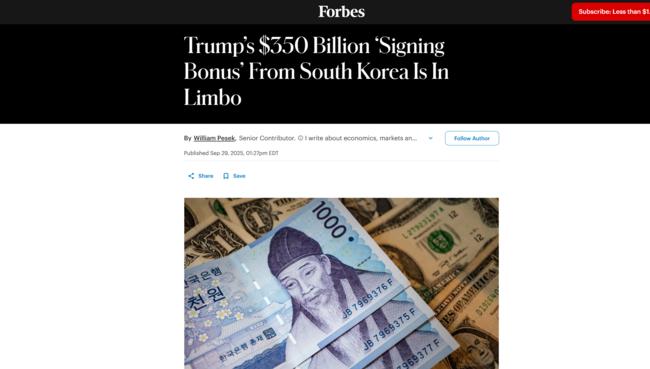
 Forbes 한미 관세협상 보도 (이미지=Forbes 홈페이지)
미국의 저명한 경제 전문지인 Forbes에서 한미 관세협상에 대해 보도했다.
Forbes는 1917년 설립되었고 포브스 글로벌 2000(Forbes Global 2000), 가장 영향력 있는 사람들(The World's Most Powerful People), 세계 억만장자 순위(The World's Billionaires) 등 매년 발표하는 영향력 있는 리스트로 전 세계적인 명성을 얻고 있다.
< 트럼프가 한국에 요구한 3,500억 달러의 ‘헌납금(Signing Bonus)’이 불투명해지다 >
윌리엄 페섹
2025년 9월 29일 오후 1시 27분 (미국 동부 표준시)
한국 경제는 심각한 타격에도 버틸 수 있는 나라입니다.
1997년 아시아 금융 위기 이후, 한국은 경제가 파탄 났던 나라 중 가장 먼저 회복했습니다. 2008년과 2009년에는 헤지펀드들이 예상치 못한 방식으로 ‘리먼 사태’를 헤쳐나갔습니다. 아시아 4위 경제 대국이 “제2의 아이슬란드”가 될 것이라는 이야기는 현실이 되지 않았습니다.
2013년 미국 연방준비제도(Fed)의 ‘긴축 발작(taper tantrum)’이 개발도상국을 뒤흔들 때도 한국은 큰 영향을 받지 않았습니다. 도널드 트럼프 대통령의 첫 임기(2017~2021년) 때 무역 전쟁이 발발했을 때도 한국은 굳건히 버텼습니다. 코로나19가 닥쳤을 때도 한국은 낮은 감염률의 모범 사례였습니다. 2021년 8월에는 한국은행이 주요 12개 중앙은행 중 가장 먼저 통화 긴축에 나섰습니다.
하지만 이번 주, 한국은 뛰어난 방어 능력뿐만 아니라 뜻밖의 일격도 날릴 수 있다는 것을 보여주고 있습니다.
트럼프에게는 알리지 마세요. 이재명 대통령의 참모진이 7월 말 워싱턴과 서울이 합의한 관세 협정의 세부 사항에 대해 강하게 버티고 있습니다.
제대로 된 마피아 영화를 본 사람이라면, 트럼프 진영의 15% 관세를 대가로 한국에 3,500억 달러를 요구하는 상황을 두고 “무역 협정”이라고 부르기를 주저할 것입니다. 일본이 지불해야 할 것으로 예상되는 조공금(tribute payment)은 5,500억 달러입니다.
하지만 미국과 한국이 악수를 나눈 이후 몇 가지 일이 발생했습니다. 첫째, 트럼프와 그의 경제팀이 아시아 국가들과의 거래에 대해 사용하는 언어가 매우 서툴렀습니다. 트럼프는 이 거액의 지불금을 “헌납금(signing bonus)”이라고 불렀고, 무역 보좌관 피터 나바로는 “백지수표(blank check)”라고 했습니다. 하워드 루트닉 상무장관은 “국가 안보 주권 기금(national security sovereign fund)”이라고 표현했습니다.
이러한 표현들은 이재명 대통령이 5,100만 한국 국민에게 관세 협정을 설득하기 어렵게 만들었습니다. 조지아주에 있는 현대-LG 배터리 공장을 ICE 요원들이 급습하여 수백 명의 한국인을 구금한 사건 또한 트럼프 행정부에 대한 한국 국민의 호감을 얻기는커녕 악화시켰습니다.
한편 일본에서는 차기 총리 후보 두 명 중 한 명이 미국과의 관세 협정을 재협상해야 할 수도 있다고 시사하고 나섰습니다.
다카이치 사나에는 트럼프 진영이 도쿄에 요구하는 수천억 달러에 대해 현지 TV에 출연해 “협정 이행 과정에서 일본의 이익에 반하는 부당한 점이 발견된다면 우리는 굳건히 맞서야 한다”며 “재협상 가능성도 포함된다”고 말했습니다.
그러나 서울에서는 이보다 훨씬 더 큰 깨달음이 있었습니다. 한국이 트럼프가 요구하는 천문학적인 돈을 현금으로 인출하여 넘겨줄 경우, 경제가 불안정해질 수 있다는 현실 인식입니다.
이재명 대통령은 이달 초 한국이 루마니아 GDP에 해당하는 금액을 백악관에 송금하지 않을 것임을 시사했습니다.
이재명 대통령은 지난 9월 19일 로이터 통신과의 인터뷰에서 “통화 스와프 없이 미국이 요구하는 대로 3,500억 달러를 인출하여 모두 미국에 현금으로 투자해야 한다면, 한국은 1997년 금융 위기와 같은 상황에 직면할 것”이라고 말했습니다.
이는 일종의 경고였습니다. 이번 주말, 위성락 국가안보실장은 한국이 국내총생산(GDP)의 18%이자 올해 국가 예산의 70%에 달하는 금액을 현금으로 내주는 것은 현실적으로 불가능하다는 결론을 내렸음을 분명히 했습니다.
그는 채널A 뉴스에 “우리의 입장은 단순히 협상 전술이 아니다”라며 “객관적, 현실적으로 우리가 감당할 수 있는 수준이 아니다. 3,500억 달러를 현금으로 지급할 수 없다”고 말했습니다.
다른 관점에서 보면, 트럼프가 요구하는 금액은 한국 외환보유액의 80% 이상입니다. 물론 트럼프는 이 소식에 불만을 가질 것입니다. 그는 전액을 “선불(up front)”로 받기를 원하고 있습니다.
한국의 전략 중 일부는 법원이 트럼프의 관세, 나아가 그의 '헌납금'이 무효라고 판결할 때까지 시간을 버는 것일 수도 있습니다. 이는 일본의 계획과도 일치합니다. 이 대통령과 이시바 시게루 일본 총리 모두 수천억 달러가 트럼프팀에게 보내지면, 설령 대법원이 판결하더라도 그 돈을 되찾을 방법은 거의 없다는 것을 알고 있습니다.
문제는 이제 어떻게 될 것이냐는 것입니다. 트럼프가 한국의 관세율을 높이려 할까요? 한국 자동차 제조사를 겨냥할까요? K-팝에 대한 대규모 세금을 부과할까요? ‘안 돼’라는 말을 들어본 적 없는 대통령이 다음으로 무엇을 할지는 아무도 모릅니다.
다행인 점은 한국은 진정한 타격을 견딜 수 있다는 것입니다. 그리고 지금 트럼프 진영으로부터 몇 번의 큰 타격을 받을 준비를 하고 있을지도 모릅니다.
△ 긴축 발작(Taper Tantrum)
ㅣ 중앙은행이 통화 정책의 '양 量'을 줄이려는 신호만 보냈음에도 불구하고, 시장이 금리 인상에 대한 공포로 과민 반응하여 일어난 급격한 금융시장 충격을 뜻한다. 통화정책의 출구 전략(Exit Strategy) 과정에서 발생하는 일종의 부작용이다.
ㅣ 2013년 5월, 벤 버냉키(Ben Bernanke) 미국 연방준비제도 의장이 양적 완화 축소(긴축, Tapering) 가능성을 처음 시사했을 때 전 세계 금융시장에서 발생했던 혼란을 '긴축 발작' 용어로 표현했다.
ㅣ 1단계 양적 완화(QE) → 2단계 양적 완화 축소(긴축, Tapering) → 3단계 긴축 발작(Taper Tantrum) 순서로 이어진다.
ㅣ 양적 완화(QE)는 중앙은행이 경기를 부양하기 위해 대규모로 국채 등을 매입하여 시장에 유동성(돈)을 공급하는 것이다. 공급이 많아지므로 유동성(돈)의 가격인 금리가 내려가고, 위험 자산인 개발도상국(Emerging Markets)으로 대규모 자본이 유입된다.
ㅣ 양적 완화 축소(긴축, Tapering)는 경기가 회복되었다고 판단하여 국채 매입 규모를 점진적으로 줄이는 것이다. 공급이 적어지므로 유동성(돈)의 가격인 금리가 급등한다.
ㅣ 긴축 발작(Taper Tantrum)은 금리 급등으로 인해 위험 자산인 개발도상국에서 대규모 자본이 유출되므로, 개발도상국의 환율이 급등하고 주식 시장의 변동성이 커진다. 2013년 당시 터키, 인도, 인도네시아, 브라질 등이 큰 타격을 받았다.
△ 윌리엄 페섹
ㅣ "세계가 일본의 잃어버린 수십 년에서 배울 수 있는 것(Japanization: What the World Can Learn from Japan’s Lost Decades)"의 저자로, 미국 비즈니스 편집자 및 기자 협회(Society of American Business Editors and Writers) 논평 부문 수상자다.
< Trump’s $350 Billion ‘Signing Bonus’ From South Korea Is In Limbo >
By William Pesek
Sep 29, 2025, 01:27pm EDT
South Korea is an economy that can take a serious punch.
Following the 1997 Asian financial crisis, it was the first economically shattered nation to recover. In 2008 and 2009, South Korea navigated around the “Lehman shock” in ways hedge funds didn’t expect. Talk of Asia’s No. 4 economy becoming the “next Iceland” didn’t bear out.
In 2013, the Federal Reserve’s “taper tantrum” rocked developing nations everywhere. South Korea, not so much. When President Donald Trump’s first 2017-2021 trade war hit, South Korea stood its ground. And when Covid-19 hit, South Korea was an exemplar of low infection rates. In August 2021, the Bank of Korea was the first top-12 central bank to tighten.
This week, though, South Korea is demonstrating it's not just great at defense, but it can land the odd blow.
Don’t tell Trump, but President Lee Jae Myung’s team is standing its ground on the particulars of the tariff deal on which Washington and Seoul agreed in late July.
Anyone who’s seen a decent mafia movie might feel reluctant to call it a “trade deal.” Not when Trump World is demanding $350 billion from Korea to get a 15% import tax. Japan’s expected tribute payment is $550 billion.
But a few things have transpired since the U.S. and South Korea shook hands. One, Trump and his economic team got very clumsy with their language concerning deals in Asia. Trump called the ginormous payments a “signing bonus.” Trade adviser Peter Navarro calls them a “blank check." Commerce Secretary Howard Lutnick calls them a "national security sovereign fund."
Such phraseology made it harder for Lee to sell the tariff arrangement to South Korea’s 51 million people. ICE agents raiding a Hyundai-LG battery plant in Georgia — and detaining hundreds of Koreans — hardly endeared Trump’s White House to the Korean masses.
Over in Japan, one of the two main candidates to be the next prime minister is suggesting a renegotiation of the U.S. tariff deal might be needed.
“We must stand our ground if anything unfair that is not in Japan’s interests comes to light in the process of implementing the deal,” Sanae Takaichi said on local television about the hundreds of billions of dollars Trump World is demanding from Tokyo. “That includes a potential renegotiation.”
Yet something even bigger happened in Seoul: the realization that South Korea simply can’t hand over the mountain of money Trump demands in cash without destabilizing its economy.
Lee set the stage for South Korea not to transfer the equivalent of Romania’s GDP to the White House earlier this month.
“Without a currency swap, if we were to withdraw $350 billion in the manner that the U.S. is demanding and to invest this all in cash in the U.S., South Korea would face a situation as it had in the 1997 financial crisis,” Lee told Reuters on September 19.
That was the heads-up. This weekend, National Security Adviser Wi Sung-lac left no doubt that Seoul has decided that forking over 18% of the country's GDP — and 70% of this year’s national budget — is simply not feasible.
“Our position is not a negotiating tactic,” he told Channel A News. “It’s objectively and realistically not a level we are able to handle. We are not able to pay $350 billion in cash.”
Looked at another way, the loot Trump demands represents more than 80% of South Korea’s foreign reserves. Trump won’t be happy, of course. He’s looking for the whole amount “up front.”
Part of South Korea’s tactic may be to buy time to see if the courts rule Trump’s tariffs, and by extension his signing bonuses, null and void. This is Tokyo’s plan, too. Both Lee and Japanese Prime Minister Shigeru Ishiba know that once hundreds of billions of dollars are sent to Team Trump there’s little recourse to get it back, regardless of what the Supreme Court says.
The question is what happens now. Does Trump try to boost South Korea’s tariff rate? Does he go after Korean automakers? A big tax on K-pop acts? Who knows what a president who’s not used to hearing “no” does now.
The good news is that South Korea can really take a punch. And it may be about to take a few big ones from Trump World.




 한국 주식을 언제든/어디서든/믿고/편리하게 살 수 있게 시간/공간/불신/불편 장벽 해소
 현대자동차그룹 '2026 CES 선언'의 의미
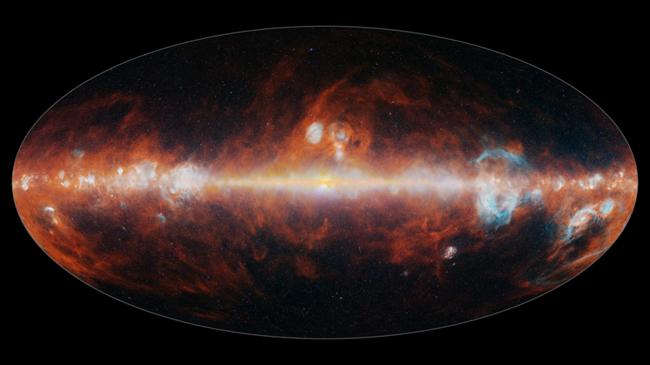 21세기 천상열차분야지도, 스피어엑스 우주 지도
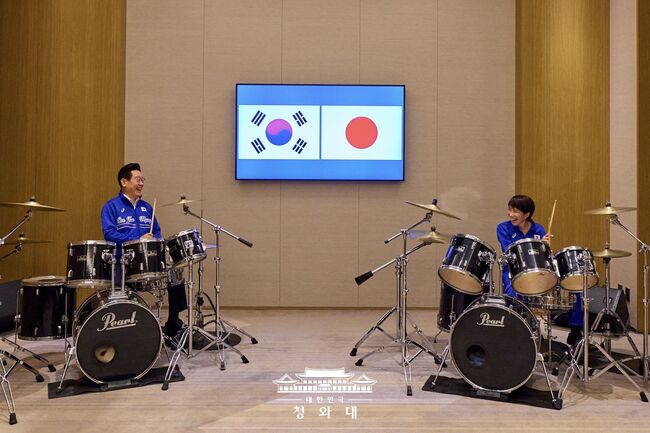 한일 정상회담 및 주요 성과 관련 대국민보고
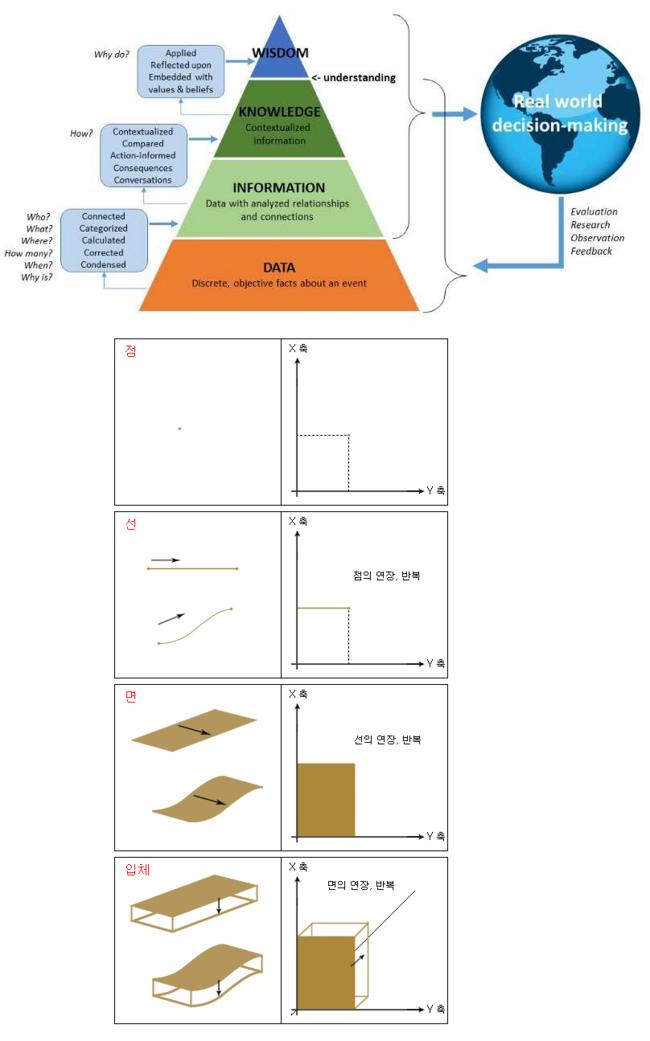 혐오하지 않을 용기
 목록
목록